

L'Mashkr: The Millennial Rite
The Tricarico carnival is an explosion of colours, sounds and ancestral traditions that come alive every year through the streets of the village.
History and Symbolism
A Rite from the Depths of Time
At dawn on January 17th, the feast day of Sant'Antonio Abate, the village of Tricarico wakes to a sound that does not belong to this age. Cowbells begin to ring through the alleys of the Rabatana, and the town transforms. What appears to be a carnival is, in reality, something far older: an agro-pastoral rite in which the entire community stages the transhumance — the great seasonal migration of flocks between mountains and plains.
The roots of the rite run deep into the Lucanian cultural substratum, to a time when human life was governed by the cycles of nature and the labour of the land. The mask was not a costume for celebration: it was a temporary identity, a way to invoke the fertility of fields, the health of herds, the prosperity of the village. This is not folklore. This is living memory.

Cows and Bulls of the Tricarico Carnival in procession · © Wikimedia Commons (CC BY-SA)

Traditional Cow and Bull masks of Tricarico · © Wikimedia Commons (CC BY-SA)
Cows, Bulls and the Mascararo
The procession is divided into two groups: the Vacche (Cows), dressed in pale costumes with delicate cowbells, and the Tori (Bulls), wrapped in dark cloaks with heavy bells. They are not mere performers: they represent a herd in motion, with its moods, its hierarchies, its skirmishes. At the head walks the mascararo, the figure who drives the hypnotic cowbell rhythm.
The mask heads, hand-sculpted in papier-mâché, reproduce the features of the animals with extraordinary precision. Every detail — the fur, the horns, the gaze — is the fruit of a tradition passed down by hand from generation to generation in the workshops of the village. Wearing them means crossing a threshold, between human and animal, between the sacred and the profane.
The Procession and the Mask's Funeral
The procession moves through the squares and alleys of the historic centre to the obsessive beat of cowbells. It is a physical sound, felt in the chest before it reaches the ears. Residents lean from balconies, children follow the cortege, and visitors stand transfixed by something that defies any tourist category.
The carnival concludes with the "funeral" of the mask: a symbolic rite in which the Carnival figure is buried or burned, marking the passage into Lent. It is the highest and most ancient moment: the one in which the community acknowledges that every feast has its limit, that every abundance precedes a time of reflection. In that funeral lies all the peasant wisdom of a people.
"The Carnival of Tricarico is not a spectacle. It is a communal act. Those who watch from the outside see costumes. Those who live it from within, see a world."— Testimony of a Tricarico resident
Glimpses of the Carnival


International Anthropological Mask Gathering
Since 2011, every summer, Tricarico becomes the crossroads of cultures, rites and identities that the contemporary world risks losing forever.
Founded by the Pro Loco di Tricarico, the International Anthropological Mask Gathering was born as a showcase for the demo-ethno-anthropological traditions of Lucania, progressively opening up to national and international communities. Today it is a reference point for scholars, researchers and folklore groups from every corner of the world.
The gathering is not a simple costume parade. It is a dialogue between cultures that share the same awareness: that the mask, at every latitude, is a universal language. An ancient way of telling who we are, where we come from, what we fear and what we celebrate.
"The mask does not hide the face. It reveals it."— Spirit of the Tricarico Gathering
Tricarico, Basilicata · Photo by Pasquale Lamarra
The masks of the world in Tricarico
Over the course of its editions, the gathering has welcomed masked groups from Bolivia, Portugal, Bulgaria, Spain, Romania and numerous regions of Africa and the Mediterranean, alongside the most important expressions of Lucanian carnival.
 Bolivia
 Portugal
 Bulgaria
 Spain
Spain Romania
 Italy
Italy Morocco
 Greece
 Albania
 France
15th Edition — Tricarico 2026
4 · 5 · 6 September 2026 — Folklore and Tradition


Programma Ufficiale Pubblicato
Consulta gli orari e i gruppi partecipanti
Date
4 · 5 · 6 September 2026
Place
Historic Centre, Tricarico
Themes
Maschere e Sapori dal Mondo
Participants
12 Regioni & Nazioni partecipanti
Programma
Vedi orari e concerti
Maschere da
Ecuador, Spagna, Bolivia...
Resta aggiornato in tempo reale ed esegui il download del programma completo:
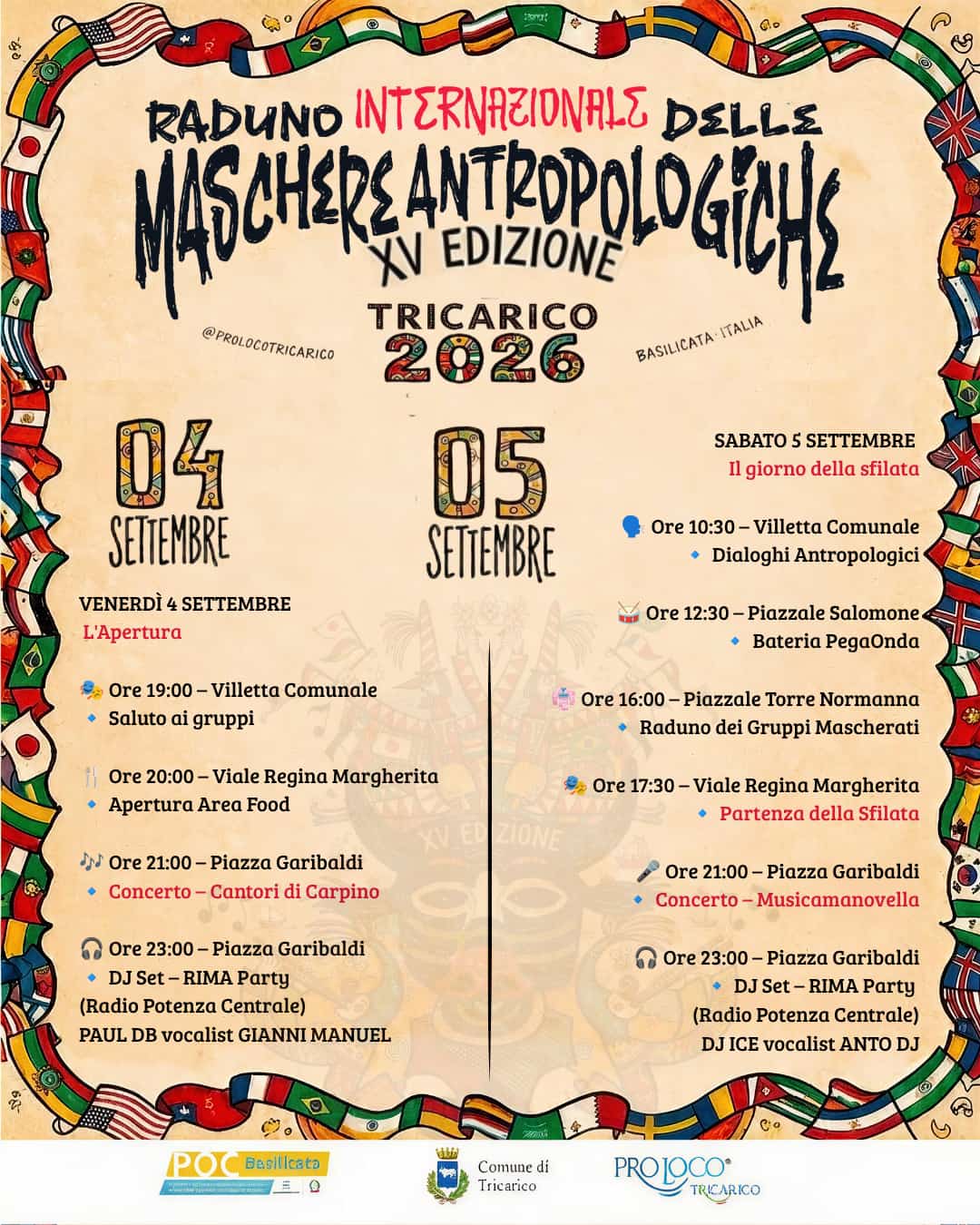
A rich and immersive programme
International Parade
The heart of the gathering: hundreds of costumed performers wind through the ancient village streets.
Conferences & Research
Round tables on anthropology, cultural identity and the future of popular traditions.
Exhibitions & Installations
Murals, art installations and photo exhibitions dedicated to Lucanian peasant culture.
Food & Wine Trails
Enogastronomic routes to discover the finest produce of the Lucanian territory.
Collage photos: Pasquale Lamarra (except Vacca and Toro)
The European MASKS project
The gathering is part of the "Network of Lucanian Carnivals with Anthropological Value" and collaborates with the University of Basilicata and the European MASKS project, which promotes the safeguarding of intangible heritage linked to ritual mask traditions in the Mediterranean basin.